
Geoscience Hackathon at AGU
| Date & Time: Sunday, December 10, 2017 at AGU Noon to 5:00 PM CST (but we'll keep feeding you if you're still going!) Location: New Orleans Downtown Marriott at the Convention Center, River Bend II |
You are invited to participate in a Geoscience Hackathon at AGU. Test your skills against other Geo professionals and win bragging rights as well as ZEISS favored optical equipment.
PLACEHOLDER FOR FORM ONLY
PLACEHOLDER FOR THE REGISTRATION FORM
2 Columns / image left - form right

Optional image caption
PLACEHOLDER FOR THE REGISTRATION FORM
2 Columns / form left - image right
PLACEHOLDER FOR THE REGISTRATION FORM
Optional image caption
2 Columns / headline left - form right
SUB HEADLINE
Duis autem vel eum iriure dolor in hendrerit in vulputate velit esse molestie consequat, vel illum dolore eu feugiat nulla facilisis at vero eros et accumsan et iusto odio dignissim qui blandit praesent luptatum zzril delenit augue duis dolore te feugait nulla facilisi. Lorem ipsum dolor sit amet,
PLACEHOLDER FOR THE REGISTRATION FORM
Please fill the form to register
This hackathon – hosted by ZEISS Microscopy at AGU 2017 – aims to bring microstructural analysis into the digital age, using digital tools to give insights into our data that were previously inaccessible, or tedious and painstaking to extract.
Each team will choose a challenge with the winners receiving a prize of ZEISS field binoculars or handheld magnifiers. Challenges include:
Each team will choose a challenge with the winners receiving a prize of ZEISS field binoculars or handheld magnifiers. Challenges include:
- Mineralogical segmentation of optical petrography datasets
- Correlative mineral identification using both light and electron microscopy dataset
- 3D mineral identification using correlated electron and X-ray microscopy dataset
- 3D lithological classification of heterogeneous samples All levels of coding are welcome, and assistance will be provided for those who want to learn.
Please bring your own laptop.
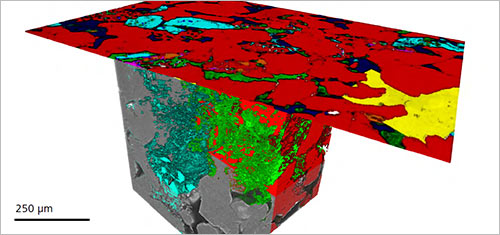
3D Mineralogy of a sandstone, found by correlating 2D EDS and 3D X-ray microscopy, and using machine learning to extrapolate classifications into 3D.